

The Case for Data Centers
The BANANAs pushback on data center construction risks ceding the global AI race and forfeiting tremendous opportunities for investment in energy infrastructure.

It’s pretty clear the American people hate data centers. And the pro-tech propaganda swirling around the internet and media is making it worse.
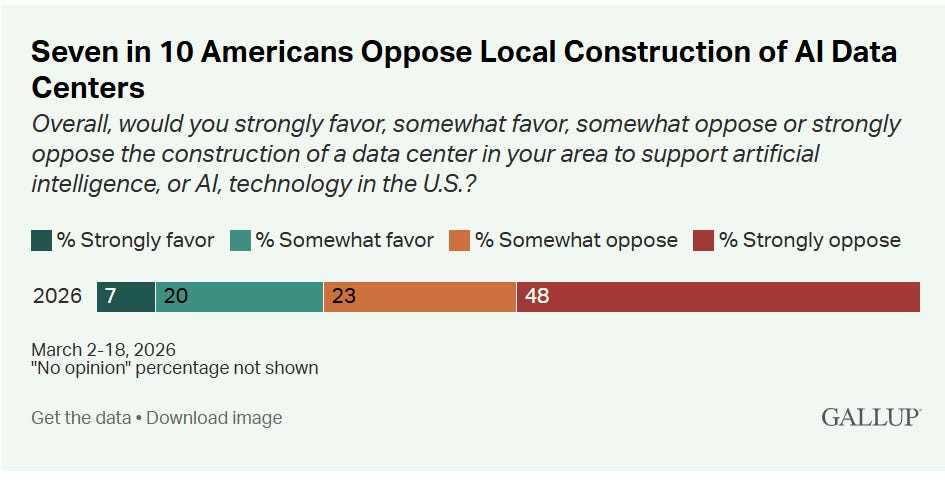
It was big news when over 70% of respondents in a May Gallup survey opposed building an AI data center in their community, with nearly half of all respondents strongly opposed. And the numbers are coming from both ends of the political spectrum: most of the opposition is concentrated in the far left and the far right, creating a rarely-seen “bipartisanship” on the emerging issue.
But most serious policymakers on both sides of the aisle acknowledge that data centers are crucial for global competitiveness, a boon to local economies and—if done right—can be a genuine gift to the grid. Big industries provide local tax revenue and jobs. Load growth funds transmission upgrades utilities couldn’t justify based on incremental gains. Large load flexibility can improve economics for everyone else on the system. And increasingly, communities are negotiating infrastructure investments that local governments couldn’t otherwise countenance.
This disconnect is a serious problem, because when politicians feed into the public backlash instead of leading through it, the problem gets worse. Already, voters are rejecting local elected officials for supporting data centers. Democrats see this risk more sharply, as their voters associate data center development with large corporate profits and environmental harms. And high-profile populists on the left like Sen. Bernie Sanders (I-VT) and Rep. Alexandria Ocasio-Cortez (D-NY) are championing a nationwide moratoria on data center construction that was just endorsed by the Ranking Member of the House Energy & Commerce Committee, putting more pressure on Democrats to take strong positions against the data center buildout.
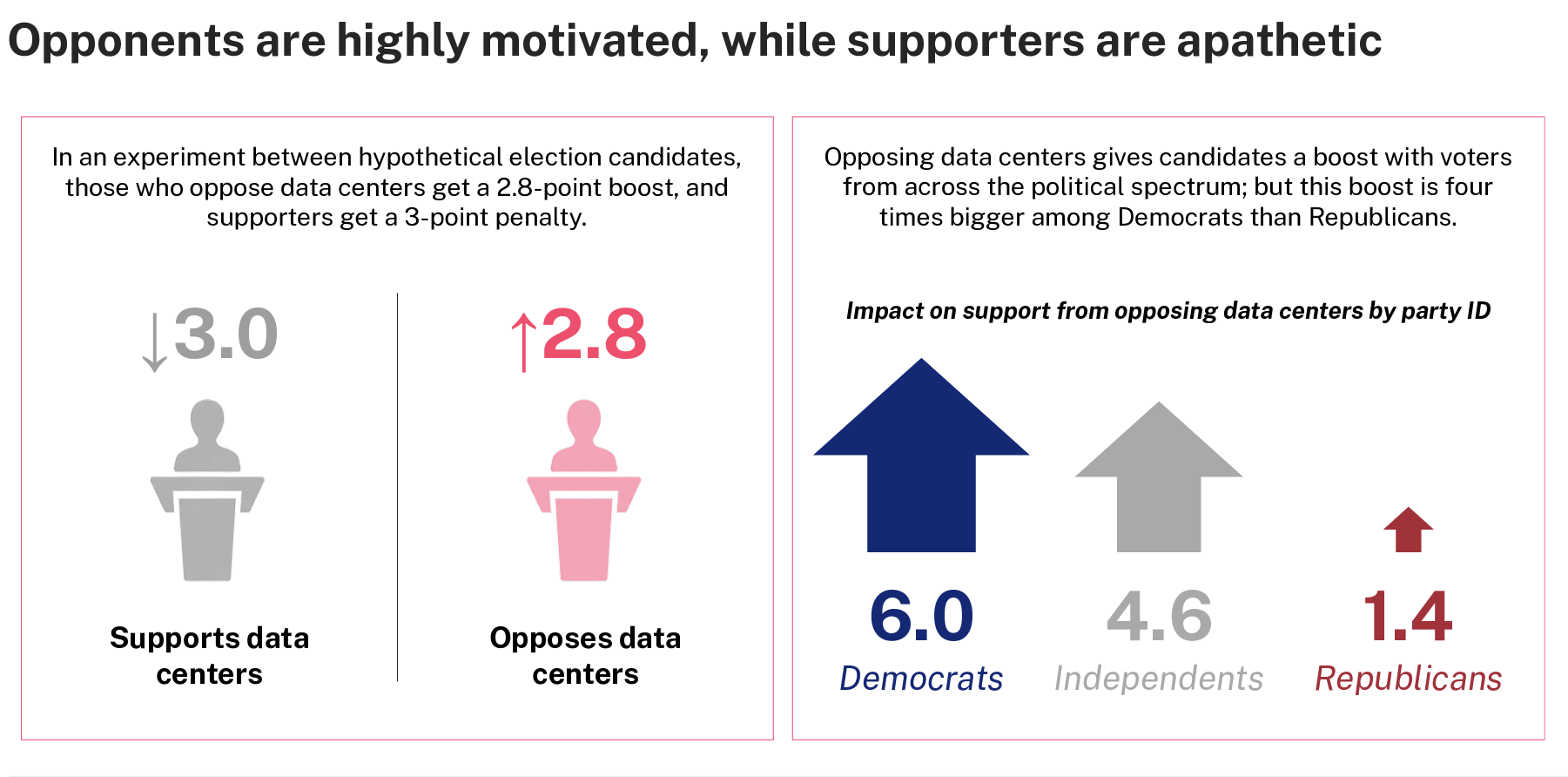
Throttling data center development not only risks all the benefits this new infrastructure can provide, but also increases the very real risk that AI will still arrive, but bearing “Made in China” on its masthead. And the conversations that get you elected right now are the opposite of the conversations that help address these issues. So policymakers need a playbook for selling data centers to a skeptical hostile public.
Proponents of a technology can experience a kind of “message blindness” when trying to change hearts and minds. Appealing to the benefits data centers provide, like online transactions and internet access, falls flat because people had those things before AI-level data centers came along. Commissioning studies that suggest “sometimes data centers reduce electricity bills,” when people can clearly see that their bills have gone up, erodes trust. And comparing data centers’ water use to golf courses really only resonates with people who already support data centers.
That’s why I want to highlight a recent study from Milltown Partners that goes deeper into the roots of public distrust of data centers. Not only does it surface the real antipathy driving the backlash (in a twist, it’s not NIMBYism, it’s a deeper hostility to big tech), it identifies five winning messages that policymakers can leverage to ensure that the concepts land:
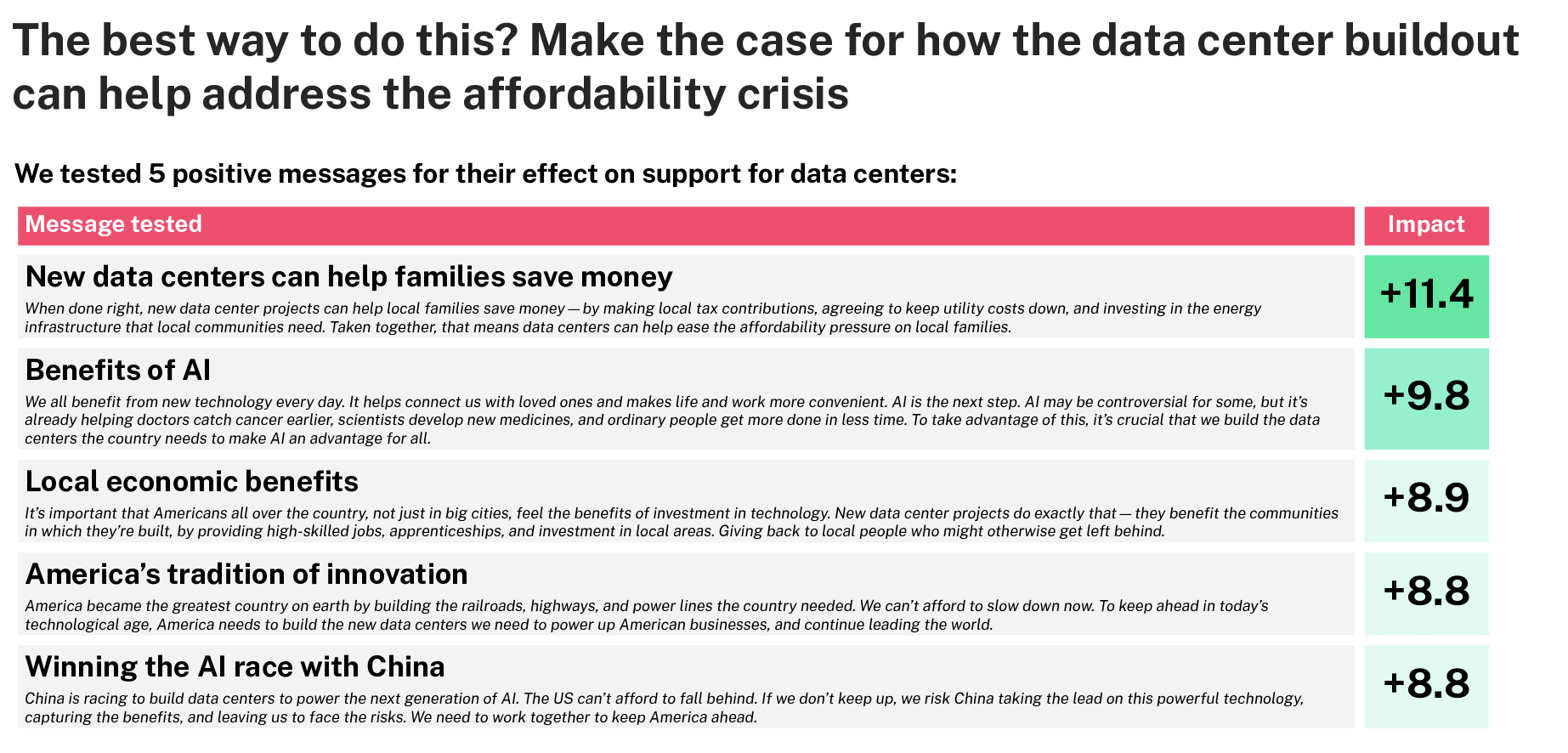
Those messages need to be backed up with actual policy, too. Former Energy Secretary Jennifer Granholm appeared on Jigar Shah’s Energy Empire podcast with a similar message for Governors: 1) Make affordability the north star; 2. Structure data centers as grid assets, not just loads; 3) Lead with hardware (like actual distributed generation assets on rooftops and garages), not promises; 4) Fix the utility business model so the utility wants this; and 5. Be honest about what policymakers can and cannot promise.
This goes for the bigger questions, as well—who will AI benefit, and can we maintain control of it? The K-shaped economy is the underlying issue, and the infrastructure debate is a proxy for that much larger, thornier fight.
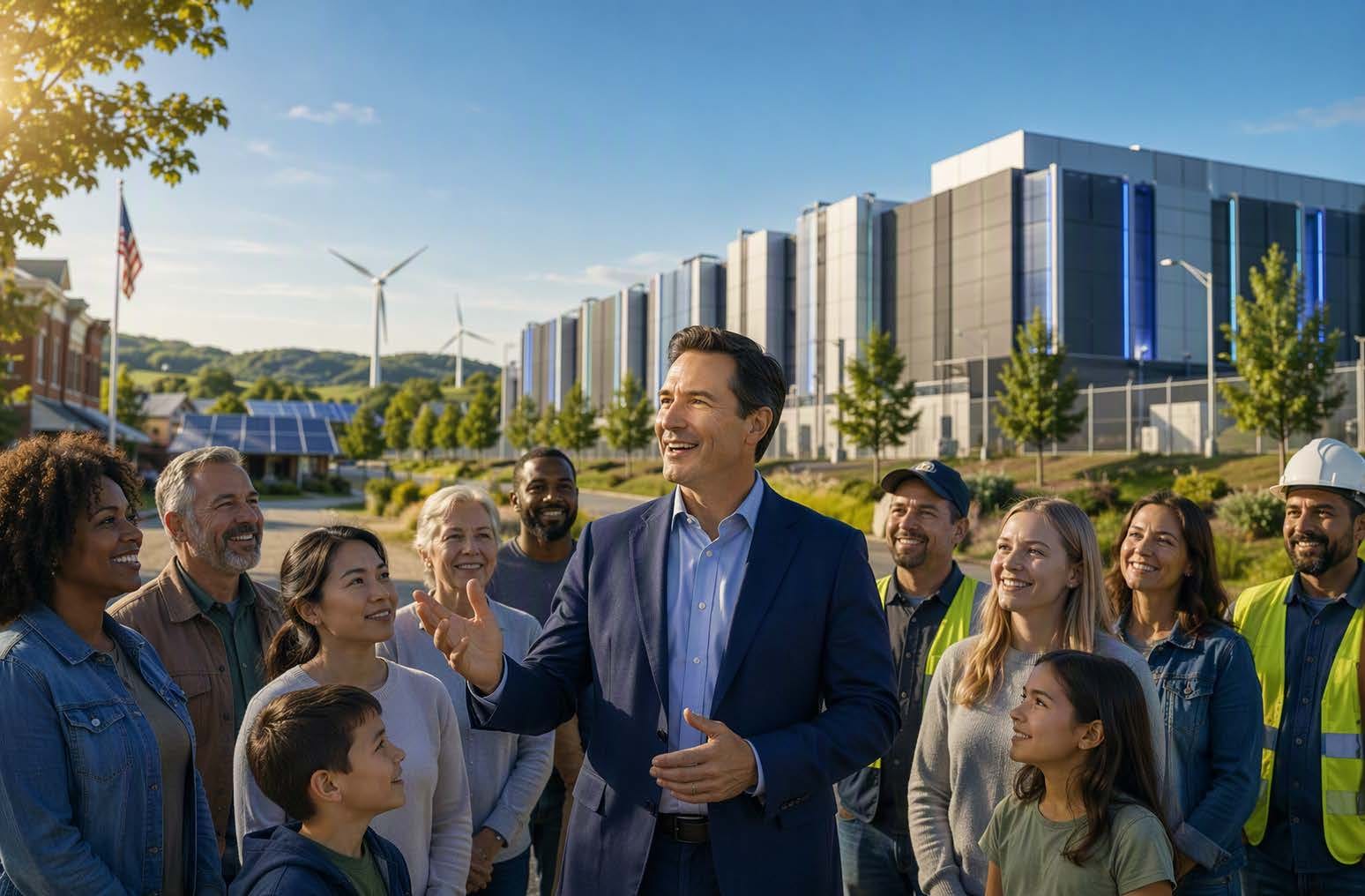
The proliferation of data centers proposes a challenge, to be sure. But shirking from it with a blanket moratorium says “we can’t solve this,” while our global competitors outbuild us. We don’t need an exit, we need a strategy. Did any of these messages change your opinion? Let me know below.
What Else I’m Watching:
Mythos 5 will soon be publicly available after the federal government lifted its block on use by foreign nationals and allowed it to be distributed to a few “trusted partners.” (Semafor)
It’s happening: Sunrun, Renew Home, and Tesla have an agreement to deliver a combined 16GW of capacity to hyperscalers through distributed energy resources. One step closer to Google buying me a rooftop solar kit. (Latitude Media)
PJM voting members STILL can’t agree on a strategy for managing large loads. Two options will go before FERC next month—a “connect and manage” plan and a one-time reliability backstop auction—but only the latter got the requisite supermajority. (EnergyWire)
A new study from Energy Innovation shows meeting load growth with renewables and storage as part of the resource mix would save $5 billion annually in fuel volatility. (Latitude Media)
A growing recognition that the value of energy is changing even if policymakers try to protect consumer rates. Brace for the fight over existing generation assets. (Data Center Knowledge)
A former PJM Board member acknowledges the pace of decision-making is its own bottleneck to development. (Latitude Media)
DOE’s loan office issued a $17.5 billion commitment to support up to ten builds of Westinghouse AP1000 nuclear reactors by procuring long lead materials. Energy Secretary Chris Wright said he hopes hyperscalers will underwrite the projects. (EnergyTech)
Google reported an 18% rise in emissions last year, a disappointing number for the company’s environmental standards. (Axios)
That’s all for this week! I’m taking the next few weeks off for a once-in-a-lifetime vacation with family, so hopefully the vitriol from my unpopular opinion above will have abated when I return. Have a safe and happy Fourth of July!
curious what survey would yield if question was "construction of a data center in your area to support cloud computing, SaaS, streaming, web hosting, data storage, etc.? This is over half of data center load, with AI at 15%, AI will increase over time, but would be interesting to see the survey results if discussing current data center use.
Perhaps opponents don't like the costs to their communities to seize these "opportunities"? Water, grid instability, pollution from off-grid gas or diesel generation? Could it just be that once people know the true costs, they don't want to be the ones to pay them for others' profit?